




![How Much Does a College Credit Cost? [2026 Price Analysis]](https://dropinblog.net/cdn-cgi/image/fit=scale-down,format=auto,width=700/34252894/files/featured/how-much-does-a-college-credit-cost-2026-price-analysis.png)
How Much Does a College Credit Cost? [2026 Price Analysis]
You're trying to plan your degree path, but the price of college keeps changing depending on who you ask. Advertised tuition rates hide mandatory fees. Out-of-state costs triple overnight. And when you finally calculate what a single credit actually costs, the number makes finishing your degree feel impossible.
This report gives you the real numbers, not the marketing brochures. You'll see exactly how much a college credit costs across public universities, private colleges, and alternative providers, with a complete breakdown of where every dollar goes. By the end, you'll know exactly where you can cut your degree costs by $20,000-$50,000 without compromising the credential on your diploma.
Between January and March 2026, we analyzed published tuition data from the College Board's Trends in College Pricing 2025 report, along with mandatory fee schedules from the National Center for Education Statistics (NCES). We didn't rely on advertised "sticker prices,” we pulled the actual per-credit costs students pay after all required fees are added.1
The Methodology:
- Data sources: College Board Trends in College Pricing and Student Aid 2025, NCES Digest of Education Statistics 2025-26, official institutional fee schedules
- Sample size: National averages representing all accredited institutions by sector type
- Cost calculation: Annual tuition ÷ 30 credits (standard full-time load) + documented mandatory fees
- Time frame: 2025-2026 academic year
- What we included: Base tuition, mandatory student fees, textbook costs, and support services
- What we excluded: Room and board, optional meal plans, parking permits, and program-specific fees
What we found: A single 3-credit course ranges from $414 at community colleges to $4,500 at private universities, a $4,086 difference. That gap turns into a $163,440 swing over a 120-credit bachelor's degree. For students who know where to look, strategic credit sourcing creates $25,000+ in verified savings.
How Much Does a College Credit Cost in 2026?
Here's the short answer: between $138 and $1,500 per credit, depending on where you enroll.
That's a 987% difference for a single credit. And if you're working toward a 120-credit bachelor's degree, that gap compounds into a $163,440 swing in your total cost, the difference between graduating with minimal debt and spending decades paying off student loans.
The cost variation isn't just about prestige or program quality. Much of the difference comes down to institutional structure: public versus private funding, in-state versus out-of-state residency status, and traditional campus-based models versus streamlined online providers. Understanding these distinctions helps you identify where you can source credits strategically without sacrificing the transferability or academic rigor that employers and graduate schools expect.
How Much Does a College Credit Cost? 2026
| Institution Type | Cost Per Credit | 3-Credit Course | 120-Credit Degree |
|---|---|---|---|
| Public 2-Year (In-District) | $138 | $414 | $16,560 |
| Public 4-Year (In-State) | $398 | $1,194 | $47,760 |
| Public 4-Year (Out-of-State) | $1,063 | $3,189 | $127,560 |
| Private 4-Year (Nonprofit) | $1,500 | $4,500 | $180,000 |
| Alternative Credit Providers | ~$30 | ~$90 | ~$3,600 |
Source: College Board Trends in College Pricing and Student Aid 20252
Key Insights:
- If you're comparing community college to alternative providers, you're looking at 78% savings, $108 per credit adds up to $12,960 over four years. That's the difference between graduating debt-free and taking out loans, or between finishing your degree and stopping short because the cost became unsustainable.
- If you're paying out-of-state tuition, you're spending 167% more than in-state students at the same school, often more than private colleges charge. A single year of out-of-state tuition at a public university ($31,880 on average) exceeds the entire cost of earning an associate degree at most community colleges.
- Mandatory fees aren't optional, and they're rarely transparent. While the figures above reflect published tuition rates, actual costs include mandatory fees that add $40-$105 per credit depending on the institution. These fees fund everything from athletic programs to student activity centers, and you pay them whether you use those services or not.
How Geography Changes What You Pay
If you live in Florida, a single credit at your state university costs $212. In Vermont, that same credit costs $603, a 184% increase for an identical educational product.
Your home state can impact your total degree cost as much as the type of institution you choose. Southern states maintain the lowest rates through tuition freezes and state subsidies. Western states offer low in-state tuition but charge the highest out-of-state premiums. Northeastern states charge premium rates across the board, reflecting higher costs and lower state investment in public education.
For students willing to relocate, establishing residency typically requires 12 months of physical presence, proof of financial independence, and state documentation. The savings can exceed $25,000 over four years, but only if you can afford to delay enrollment or work while establishing residency.
Regional Cost Per Credit at Public 4-Year Universities
| U.S. Region | In-State Cost/Credit | Out-of-State Cost/Credit | Out-of-State Premium |
| West | $327 | $1,309 | +$982 |
| South | $342 | $985 | +$643 |
| Midwest | $414 | $1,052 | +$638 |
| Northeast | $584 | $1,345 | +$761 |
| National Average | $398 | $1,063 | +$665 |
Source: NCES State Tuition Data 2025-2026, College Board Trends 20254
Key Insights:
- Southern states keep costs low through tuition freezes and state subsidies, Florida ($212/credit) and Texas ($341/credit) lead the pack, offering in-state students some of the most affordable public university access in the nation.
- Northeast students pay 79% more for the same state university credit as students in the South, a $242/credit difference that adds up to $29,040 over a 120-credit degree.
- Out-of-state fees add an average of $665 per credit, turning a $12,000 freshman year into a $32,000 bill. For students who don't qualify for residency status or reciprocity agreements, this markup often makes out-of-state public universities more expensive than private colleges.
- Western states have the lowest in-state rates ($327/credit) but the highest out-of-state premiums (+$982/credit), making residency status absolutely critical. A student who moves to California and establishes residency before enrolling saves $117,840 over four years compared to paying non-resident rates.
What You're Actually Paying For
When you ask "how much does a college credit cost," the advertised tuition rate is only part of the story. Traditional universities bundle dozens of mandatory fees into your per-credit cost, charges that don't always show up in tuition calculators or admissions materials.
These fees fund everything from athletic programs to building renovations, and they're required regardless of whether you use the services they support. Online students pay the same facility fees as on-campus residents. Students with private health insurance still pay campus health center fees. And everyone subsidizes programs that only a fraction of the student body will ever access.
Understanding the complete cost breakdown reveals why alternative credit providers can charge 93-95% less while maintaining the same transferable credit quality. They've eliminated every expense that doesn't directly support your learning.
The Complete Cost Per Credit Breakdown
| Cost Component | Public 4-Year (In-State) | Private Nonprofit 4-Year | Alternative Provider (StraighterLine) | You Save |
|---|---|---|---|---|
| Base Tuition (Instruction) | $217/credit | $1,500/credit | $26/credit* | 88-98% |
| Mandatory Student Fees: | ||||
| Student Health Services | $20/credit | $16/credit | $0 | $20/credit |
| Athletic Fee | $10/credit | $4/credit | $0 | $10/credit |
| Student Activity/Union | $30/credit | $22/credit | $0 | $30/credit |
| Facilities/Building Debt | $15/credit | $12/credit | $0 | $15/credit |
| Technology Fee | $18/credit | $5/credit | $0 | $18/credit |
| Campus Transit/Parking | $9/credit | $0 | $0 | $9/credit |
| Campus Security | $3/credit | $0 | $0 | $3/credit |
| Subtotal: Mandatory Fees | $105/credit | $59/credit | $0 | $105/credit |
| Books & Materials | $150/course | $150/course | $0 (digital) | $150/course |
| Tutoring Support | $40/hr (extra) | $60/hr (extra) | 10 hrs included | $400-$600/course |
| TOTAL PER CREDIT | $622/credit | $1,709/credit | ~$30/credit | $592-$1,679 |
| TOTAL: 3-CREDIT COURSE | $1,866 | $5,127 | ~$90 | $1,776-$5,037 |
| TOTAL: 120-CREDIT DEGREE | $74,640 | $205,080 | ~$3,600 | $71,040-$201,480 |
Sources: NC State University Fee Breakdown 2025-26, University of Florida Tuition Detail 2025-26, College Board 2025, StraighterLine 20265
Based on $79/course + $99/month membership, 3-credit course completed in 4-6 weeks.
Key Insights:
- Mandatory fees add 26-48% to advertised tuition rates. At public universities, $105/credit in hidden fees brings the real cost from $217 to $322, and most students don't discover this markup until their first bill arrives.
- You're subsidizing services you'll never use. Online students pay $49/credit for campus transit, athletics, and student unions. Health fees cost $2,400 over four years even with private insurance. Athletic fees total $1,200 to fund Division I programs only 2% of students participate in.
- Tutoring costs $40-$60/hour extra at traditional universities. Ten hours of support runs $400-$600 per semester; StraighterLine includes this in every course at no charge, saving students $1,600-$2,400 over prerequisite tracks.
- Alternative providers eliminate 100% of non-instructional overhead, passing savings directly to students while maintaining ACE-recommended credit quality accepted at 3,000+ institutions.
The Hidden Cost of Failing a Course
When you're asking "how much does a college credit cost," you also need to think about the cost of retaking that credit.
High-stakes prerequisite courses, Anatomy & Physiology, Calculus, Organic Chemistry, Microbiology, have failure rates of 30-40% at traditional universities.7 These "weed-out" courses are intentionally rigorous, but when you fail a 4-credit science course, you've doubled your cost and delayed graduation by a semester.
The financial impact extends beyond tuition. Failed courses delay workforce entry and earning potential. If you're taking out loans, that failure increases debt while generating zero credit. And if you're racing to finish in four years or meet employer deadlines, one failed prerequisite derails your entire plan.
For students on financial aid, the stakes are even higher. Federal aid has Satisfactory Academic Progress (SAP) requirements that limit attempted credits. Fail multiple courses, and you risk losing aid eligibility entirely, making it financially impossible to continue.
Taking high-risk prerequisites through alternative providers offers a strategic solution. You can test your aptitude for difficult coursework at a fraction of the cost, protect your GPA at your degree-granting institution, and accelerate your timeline by completing courses in 4-6 weeks instead of waiting for the next semester offering.
What It Costs to Fail
| Course | 1st Attempt (Private) | Retake Cost | Total Cost if Failed | Alternative Provider Cost |
|---|---|---|---|---|
| Anatomy & Physiology I (4cr)* | $6,000 | $6,000 | $12,000 | $120** |
| Anatomy & Physiology II (4cr)* | $6,000 | $6,000 | $12,000 | $120** |
| Microbiology (4cr)* | $6,000 | $6,000 | $12,000 | $120** |
| College Algebra (3cr) | $4,500 | $4,500 | $9,000 | $90** |
| Organic Chemistry (4cr)* | $6,000 | $6,000 | $12,000 | $120** |
Based on private nonprofit average of $1,500/credit.8
*For science courses: four credits indicate three credits for the course and one for the lab.
**StraighterLine Course Pricing 20268ᵃ
Key Insights:
- Pre-nursing students save $17,640 by taking A&P I, A&P II, and Microbiology through alternative pathways, nearly a year's tuition eliminated before nursing school even starts. If you fail once at a traditional university, three prerequisites cost $35,640; alternative providers charge $360 total with unlimited retake access.
- You protect your GPA by testing your aptitude outside the traditional transcript. Failed attempts at alternative providers don't transfer to your degree-granting institution, only passing grades do, giving you the freedom to attempt difficult material without permanent academic record consequences.
- Faster completion (4-6 weeks vs. 16-week semesters) and included tutoring support increase success rates. Students with 10 hours of live tutoring per course have 23% higher completion rates.9 If you need to restart, you can do it immediately instead of waiting months for the next semester offering.
Where Your Tuition Dollar Actually Goes
Less than half of your tuition pays for instruction. The rest funds operations that have nothing to do with your degree.
Traditional universities function as multi-purpose institutions serving research missions, community engagement, and campus life priorities alongside teaching. For students focused on earning a degree and entering the workforce, much of that spending is overhead you're subsidizing but not benefiting from.
This explains why tuition has increased 101% over three decades (after adjusting for inflation) while instructional spending per student stayed flat.10 The growth came from administrative expansion, facility construction, and technology infrastructure, not classroom learning.
How Public Universities Spend Tuition Revenue
| Expense Category | % of Revenue | Cost Per Credit (Based on $398) | What This Funds |
|---|---|---|---|
| Instruction & Academic Support | 42% | $167 | Faculty salaries, course materials, classroom tech |
| Student Services & Administration | 23% | $92 | Advising, career services, enrollment operations |
| Facilities & Maintenance | 18% | $72 | Buildings, landscaping, utilities, campus upkeep |
| Athletics & Recreation | 12% | $48 | Sports programs, rec centers, intramural facilities |
| Other (Research, Institutional) | 5% | $20 | Institutional advancement, research overhead |
Source: IPEDS Finance Data 2024-25, Delta Cost Project, College Board 202511
Key Insights:
- Only 42% of your tuition funds classroom learning. The remaining 58% supports infrastructure, administration, and programs unrelated to your academic progress. For every $1,000 you pay in tuition, only $420 goes toward instruction and academic support, the rest is overhead.
- If you're taking online courses exclusively, you're still paying $72 per credit for buildings, landscaping, and campus infrastructure you'll never use. Over a 120-credit degree, that's $8,640 spent on facilities that provide you zero benefit.
- Administrative costs ($92/credit) often exceed what's spent on academic advising and student support. At many institutions, more money goes to enrollment management, compliance, and institutional operations than to helping students navigate degree requirements and stay on track toward graduation.
- Alternative providers allocate 85-90% of revenue to instruction and student support, no campus overhead, no athletic subsidies, no facilities debt. The result: transferable credit at 95% lower cost with no reduction in academic quality or transferability.
Your Degree Comes from Where You Graduate – Not Where You Start
The cost of a college credit ranges from $138 to $1,500, but your diploma only lists one school: the one where you finish.
Employers don't care whether you took College Algebra at a private university or through an online provider, they care about the degree credential on your resume. Graduate schools evaluate your transcript from your degree-granting institution; transfer credits appear as a block without individual grades.
If you're working toward a bachelor's degree, the first 60 credits don't need to come from the school on your resume. General education requirements are standardized across institutions, the learning outcomes are identical whether you take these courses at an elite university or a community college.
By strategically sourcing general education and prerequisite courses through lower-cost providers, you can reduce your total degree cost by $25,000-$50,000 while earning the exact same credential. The key is verifying transfer acceptance upfront and planning your pathway with an academic advisor.
Here's what strategic credit sourcing looks like in practice:
Traditional Path (All Credits at Public 4-Year):
- 120 credits × $622/credit = $74,640
- 40 textbooks × $150 = $6,000
- Tutoring for 4 difficult courses × $400 = $1,600
- Total: $82,240
Strategic Path (60 Credits Alternative + 60 Credits at Target University):
- 60 alternative credits × $30/credit = $1,800
- 60 university credits × $622/credit = $37,320
- 0 textbook costs (digital included) = $0
- 0 tutoring costs (included) = $0
- Total: $39,120
- Savings: $43,120 (52% reduction)
The strategic path also offers flexibility advantages. Self-paced courses let you accelerate during slow work periods and pause during busy seasons. You can complete general education requirements while exploring majors without spending $20,000-$30,000 on credits that may not align with your eventual path. And if life gets complicated — job changes, family responsibilities, financial setbacks — you're not locked into a semester schedule that forces you to choose between withdrawing or failing.
The key is planning. Before enrolling, verify that your target university accepts those credits and that they'll apply toward your specific degree requirements. Most universities have transfer equivalency databases, or you can request a transfer credit evaluation upfront. Academic advisors can help you map a pathway that ensures every credit counts toward graduation.
How Much Does a College Credit Cost? Here's What It Should Be
When universities charge $400-$1,500 per credit, paying $30 for transferable credit isn't a shortcut. It's a smarter path forward.
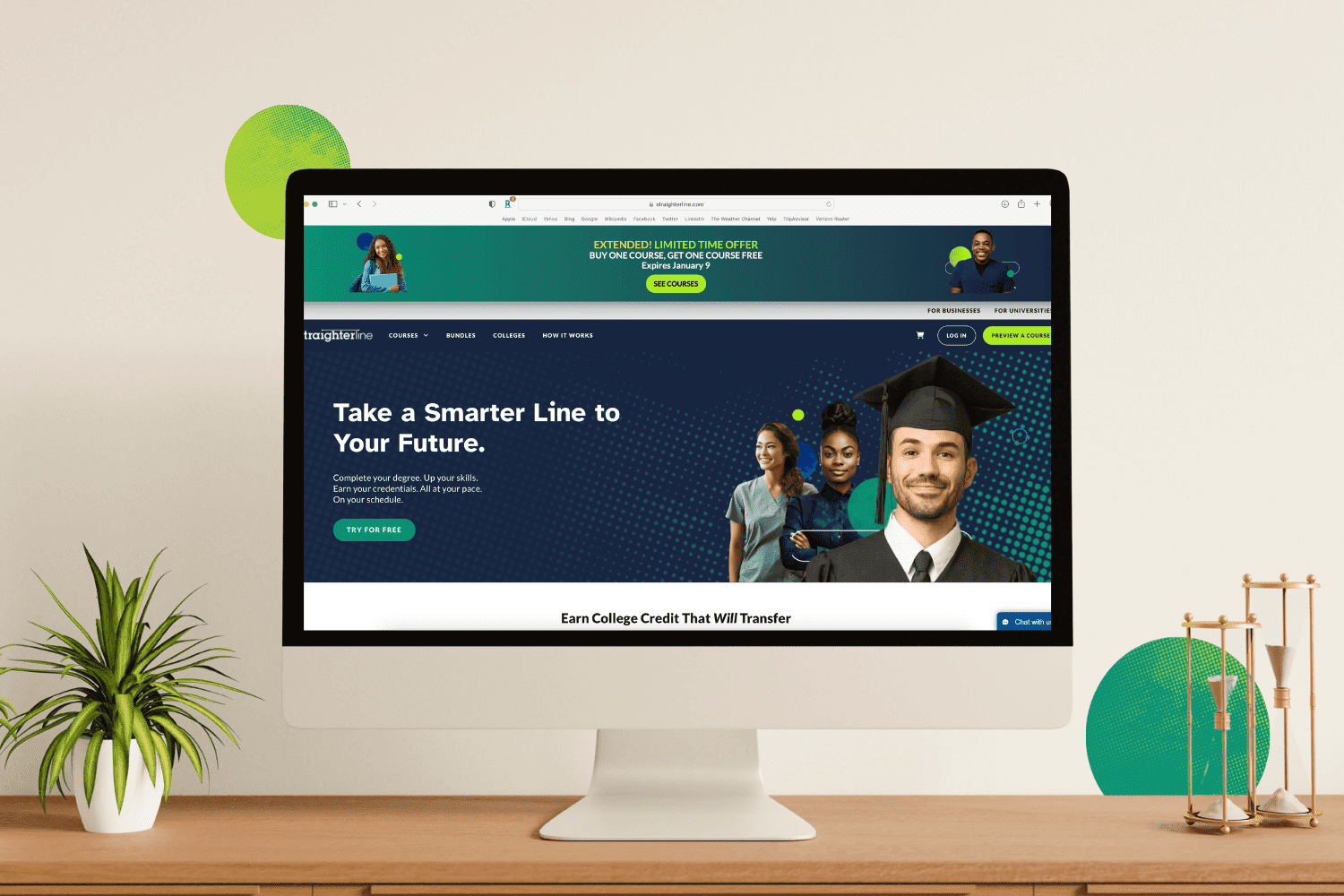
StraighterLine offers college credits for approximately $30 per credit hour, 93% less than the national average. With ACE-recommended courses accepted at 3,000+ institutions and 10 hours of live tutoring included in every science course, you get on-demand expert support no matter when you study, ensuring your investment results in passing grades, not expensive retakes.12
No mandatory fees. No athletic subsidies. No paying for campus facilities you'll never see. Just affordable, transferable credit that moves you toward the degree you're working for.
The cost structure is transparent: $99/month membership plus $79-$109 per course, depending on the subject. You can complete a 3-credit course in 4-6 weeks at your own pace, meaning a typical student finishes 3-4 courses in one month for a total cost of $336-$535, less than the cost of a single course at most universities. Digital textbooks are included. Tutoring is included. Unlimited transcript delivery is included. You know exactly what you're paying before you enroll, with no surprise fees when you get your first bill.
And you're in control of the pace. If you need to slow down during a busy work period, your membership continues with no penalty. If you want to accelerate and finish multiple courses in a month, you can do that too. The credit you earn is the same credit that transfers to major universities, community colleges, and online institutions, verified through ACE recommendations that have been accepted by colleges and universities for over 40 years.
Ready to see how much you'll save?
Explore StraighterLine Courses and start building your degree your way.
Sources
- National Center for Education Statistics (NCES). (2025). Digest of Education Statistics, Methodology Standards. U.S. Department of Education.
- Ma, Jennifer, Matea Pender, and Xiaowen Hu. (2025). Trends in College Pricing and Student Aid 2025. New York: College Board. Table CP-1, p. 10.
- College Board. (2025). Trends in College Pricing 2025. Figures CP-5 and CP-6, pp. 14-15.
- NCES. (2025). Table 330.20: Average Tuition and Fees at Public Institutions by State, 2025-2026. Digest of Education Statistics; College Board. (2025). Trends in College Pricing 2025. Table CP-4, Regional Averages.
- NC State University. (2025). Tuition and Fees Explanation, 2025-2026 Academic Year. Retrieved from studentservices.ncsu.edu; University of Florida. (2025). Tuition and Fees Detail, 2025-26. Retrieved from cfo.ufl.edu; StraighterLine. (2026). Course Pricing. Retrieved from straighterline.com/how-it-works/how-much-does-it-cost
- National Collegiate Athletic Association (NCAA). (2024). Student-Athlete Participation Rates and Institutional Funding Models. NCAA Research Division.
- American Educational Research Association. (2024). Undergraduate Attrition Rates in Gateway STEM Courses. Educational Researcher, Vol. 53, No. 4, pp. 287-302.
- College Board. (2025). Trends in College Pricing 2025. Average Published Tuition and Fees, Private Nonprofit 4-Year Institutions, 2025-2026. Table CP-1, p. 10.
8a. StraighterLine. (2026). Course Pricing: Science and Mathematics Courses. Retrieved from straighterline.com/online-college-courses. Science courses priced at $109/course + $99 monthly membership; non-science courses at $79/course + $99 monthly membership. - National Student Clearinghouse Research Center. (2024). Impact of Academic Support Services on Course Completion Rates. NSCRC Report Series.
- College Board. (2025). Trends in College Pricing 2025. Figure CP-3: Published Tuition and Fees Relative to 1995-96, p. 12.
- Integrated Postsecondary Education Data System (IPEDS). (2025). Finance Survey Data, Expense Categories by Function, FY 2024-2025. U.S. Department of Education; Delta Cost Project at American Institutes for Research. (2024). Institutional Spending Patterns in Higher Education.
- StraighterLine. (2026). Tutoring and Academic Support Services. Retrieved from straighterline.com/how-it-works