




Healthcare can be a rewarding field, especially if you're planning on pursuing a nursing career. But nursing school comes with a hefty price tag, especially the prerequisites. Here's the challenge: Most nursing programs require 20-30 prerequisite credits before you can even start clinical courses, and paying for these at traditional colleges can consume a third of your GI Bill benefits before you've taken your first nursing class — a major concern for anyone trying to preserve their GI Bill for nursing school benefits
The smart strategy for maximizing your GI Bill for nursing is to complete your nursing prerequisites through affordable, self-paced online courses at a fraction of the cost, then apply your full GI Bill benefits to your nursing program where they'll cover tuition, provide housing allowance, and support you through clinical rotations. This approach can save you $5,000-15,000 on prerequisites alone while accelerating your path to becoming a registered nurse.

Why Nursing Is the Perfect Career Path for Veterans
Your military service has already prepared you for nursing success. The discipline, teamwork, and ability to perform under pressure that defined your military career are exactly the qualities that make exceptional nurses. According to the Bureau of Labor Statistics' 2026 projections, registered nursing employment is expected to grow 6% through 2032, adding approximately 177,400 new positions annually.
Nursing offers veterans:
Job security: National nursing shortage means nurses can work virtually anywhere
Strong salaries: RNs with associate’s degrees average $81,220; BSN-prepared nurses earn $86,070; Nurse Practitioners average $121,610
Career portability: Critical for military families who relocate
Clear advancement pathways: Start as RN, advance to BSN, pursue specialized roles or Nurse Practitioner positions
Mission-driven work: Continue serving others in meaningful healthcare roles
Veterans consistently excel in nursing programs because military training develops situational awareness, clear communication in high-stress environments, ability to follow protocols while thinking critically, and unwavering commitment to the mission — which in healthcare means patient safety and quality care.
Nursing School Prerequisites: The Hidden Cost Problem
Before you can take your first nursing course, you'll need to complete prerequisite courses that establish your foundation in sciences and general education. This makes planning how to use your GI Bill for nursing especially important. These prerequisites are non-negotiable — virtually every nursing program requires them for admission.
Standard Nursing Prerequisites Required:
Anatomy & Physiology I & II (8 credits with labs)
Microbiology (4 credits with lab)
General Chemistry (3-4 credits)
Introduction to Nutrition (3 credits)
Introduction to Psychology (3 credits)
Introduction to Statistics (3 credits)
English Composition I & II (6 credits)
Total Prerequisites: 20-30 credits (approximately 8-10 courses)
Here's where many people make a costly mistake. At traditional colleges, each prerequisite course costs $900-2,500 depending on the institution:
The True Cost of Traditional Prerequisites:
8 courses at community college: $3,200-7,200
8 courses at public university: $9,600-14,400
8 courses at private college: $15,000-20,000
If you use your GI Bill to pay for prerequisites at a traditional institution, you're consuming 6-12 months of your 36 months of benefits on courses that aren't even part of your nursing program. That's potentially one-third of your GI Bill spent before you ever step into a clinical rotation.
The StraighterLine Solution: Save Your GI Bill for Courses That Actually Matter
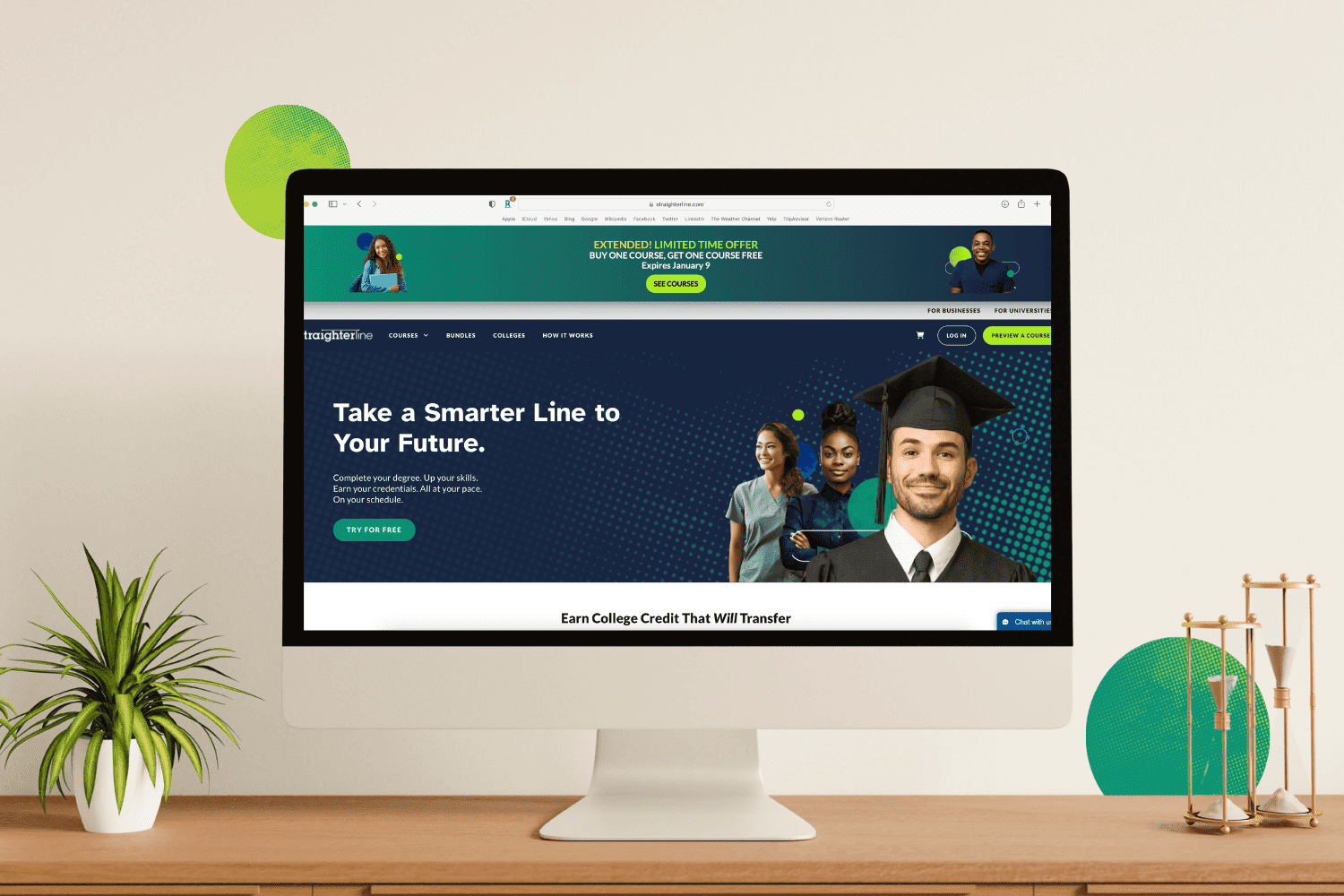
StraighterLine offers fully self-paced, ACE-recommended online courses that transfer to over 3,000 colleges and universities — including many institutions with well-regarded nursing programs. The platform provides the exact prerequisite courses nursing schools require, with the same rigorous content and learning outcomes, but with dramatically different economics.
Available Nursing Prerequisites Through StraighterLine:
Microbiology (with at-home lab)
The Cost Comparison That Changes Everything:
Provider | Cost for 8 Prerequisites | Total Cost |
Community College | $400-900 per course | $3,200-7,200 |
Public University | $1,200-1,800 per course | $9,600-14,400 |
Private University | $2,500-4,000 per course | $20,000-32,000 |
StraighterLine | $99/month + $79/course | $1,343-2,023 |
Your Savings: $5,000-15,000 on nursing prerequisites. These savings allow you to preserve more of your GI Bill for Nursing for your actual nursing program.
StraighterLine is straightforward: You pay a $99 monthly subscription that gives you access to course materials, instruction, grading, academic advising and support, and transcript processing. There’s also a $79 fee for each course you wish to take. Most dedicated students complete 2-3 courses per month, meaning you can finish all nursing prerequisites in 4-6 months for under $2,000 total.
Time Savings:
Traditional college prerequisites: 12-18 months (semester-based schedules)
StraighterLine prerequisites: 4-8 months (self-paced, continuous enrollment)
Time savings: 6-12 months to apply for nursing school earlier
Starting your nursing program 6-12 months earlier means entering the workforce earlier. If you earn $81,220 as an RN, starting even six months earlier represents $40,610 in additional earnings — making the StraighterLine investment insignificant by comparison.
Nursing Schools That Accept StraighterLine Credits
StraighterLine maintains direct credit transfer agreements with over 180 partner colleges and universities, many of which offer nursing programs:
Notable Partner Schools with Nursing Programs:
American Public University System (BSN, MSN programs)
Capella University (BSN, RN-to-BSN, MSN)
Colorado Technical University (RN-to-BSN, MSN)
Excelsior College (ADN, RN-to-BS)
Fort Hays State University (BSN, RN-to-BSN)
International College of Health Sciences (ASN, BSN, RN-to-BSN, MSN)
Purdue University Global (RN-to-BSN, MSN)
Roseman University of Health Sciences (BSN, RN-to-BSN, MSN)
Tampa Medical College (PN, ASN, BSN, RN-to-BSN, MSN)
Thomas Edison State University (BSN, RN-to-BSN, MSN)
Always verify transfer acceptance: Use StraighterLine's Find My College transfer tool and contact nursing program admissions directly before enrolling to confirm which prerequisites they accept and whether at-home labs are approved.
Strategic GI Bill Planning for Nursing Students
Strategic use of your GI Bill for nursing begins with understanding where not to spend it.
The Single Biggest Mistake to Avoid:
Using GI Bill benefits for prerequisites at traditional colleges wastes 6-12 months of benefits on general education courses, leaving less for your actual nursing program where tuition is highest and you need the housing allowance most.
The Smart Strategy:
Pay out-of-pocket for StraighterLine prerequisites: $1,500-2,000 (4-6 months)
Save full GI Bill for nursing program: All 36 months preserved
Apply GI Bill to ADN or BSN: Tuition coverage + Monthly Housing Allowance ($1,400-2,800/month for in-person programs)
Graduate with benefits remaining: Possibly enough for RN-to-BSN or MSN advancement
Why This Matters:
The Monthly Housing Allowance (MHA) for in-person nursing programs provides $28,000-70,000 over a 2-4 year program — often exceeding tuition costs. This is one of the biggest advantages of smart GI Bill for nursing planning. This income support is crucial during clinical rotations when you can't work full-time. Spending $1,500-2,000 of your own money on prerequisites preserves this valuable benefit for when you need it most.
Converting Military Healthcare Experience to College Credit
If you served in military medicine, you may earn college credit through your Joint Services Transcript (JST):
Military Medical Roles That May Transfer Credit:
Army: 68W Combat Medic, 68C Practical Nurse (LPN)
Navy: HM Hospital Corpsman (including specialized ratings)
Air Force: 4N0X1 Aerospace Medical Service
Marines: Field Medical Service Technician
How to Use Your JST:
Request free transcript at jst.doded.mil
Review recommended credits (typically medical terminology, possibly anatomy or patient care credits)
Submit JST with nursing applications
Combine JST credits + StraighterLine prerequisites + GI Bill for nursing program
Many veterans earn 6-15 college credits from military medical training alone, reducing the prerequisites they need to complete.
Your Step-by-Step Path to Nursing Degree
Step 1: Request JST Transcript (Week 1)
Visit jst.doded.mil to document military training
Review what credits you may have earned
Step 2: Research Nursing Programs (Weeks 1-3)
Identify 3-5 programs (ADN vs. BSN based on goals)
Check application deadlines (typically 6-12 months before start)
Step 3: Complete StraighterLine Prerequisites (Months 2-7)
Enroll in $99/month subscription
Complete 8-10 courses over 4-6 months
Recommended pace: 2-3 courses per month
Focus on science courses (A&P, Microbiology) individually due to difficulty
Step 4: Apply to Nursing Programs (Months 7-9)
Submit applications 6-12 months before intended start
Include: StraighterLine transcripts, JST transcript, TEAS exam scores, letters of recommendation
Apply to multiple programs (3-5) to maximize admission chances
Step 5: Activate GI Bill Benefits (3-4 months before start)
Complete VA Form 22-1990 (first-time GI Bill) or 22-1995 (change of program)
Coordinate with school's Veterans Affairs office
Verify tuition coverage and housing allowance start date
Step 6: Complete Nursing Program (2-4 years)
ADN: 2 years, approximately 600-800 clinical hours
BSN: 4 years, approximately 800-1,000 clinical hours
Accelerated BSN: 12-18 months intensive
Step 7: Pass NCLEX-RN Exam (1-3 months post-graduation)
Apply for licensure through state Board of Nursing
Take NCLEX-RN exam (national pass rate: 80-82% for first-time test-takers)
Begin working as Registered Nurse upon licensure
Total Timeline: 3-5 years from start to RN license
Real Veteran Success Story
Jason, Army Veteran → Master's in Nursing:
Jason used the exact strategy outlined in this guide. After retiring from the military, he completed Anatomy & Physiology I & II, Microbiology, General Chemistry, and Statistics through StraighterLine in just 5 months — all while being a father of six.
His results:
Saved thousands by completing prerequisites through StraighterLine ($1,680 total)
Preserved his GI Bill for graduate nursing program
Started his nursing program nearly a year earlier than traditional timeline
Currently enrolled in Master of Science in Nursing program
Frequently Asked Questions
Can I use my GI Bill for prerequisites? Yes, but it's not cost-effective. You'd spend $3,000-15,000 of benefits on general education courses. Instead, spend $1,500-2,000 on StraighterLine and save your full GI Bill for your nursing program.
How long does StraighterLine take? Most students complete all nursing prerequisites in 4-6 months studying 15-20 hours per week. Self-paced format means you can move faster if you dedicate more time.
Do nursing schools accept online prerequisites? Yes, most programs accept prerequisites from accredited online sources, especially for non-lab courses. Many accept virtual labs for science courses. Always verify with your target schools first.
Can military medics skip prerequisites? Sometimes. Your JST transcript may earn credits for medical terminology, anatomy, or patient care courses depending on your training. Submit your JST during nursing applications for evaluation.
Start Your Path to Nursing with StraighterLine Today
Your military service has prepared you for nursing success. The path is clear: complete prerequisites affordably through StraighterLine for under $2,000, preserve your full GI Bill for your nursing program, and enter a career with 6% projected growth, salaries starting at $81,220, and opportunities to continue serving others in meaningful ways.
The national nursing shortage means qualified nurses are in demand everywhere. Healthcare systems actively recruit veterans who bring discipline, critical thinking, and proven ability to perform under pressure.
Start today by enrolling in your first StraighterLine prerequisites. Within 3-5 years, you can hold your RN license and begin a rewarding career that offers financial stability and the satisfaction of making a genuine difference in patients' lives.
[View Nursing Prerequisite Courses →]
[Find Partner Nursing Schools →]
Last updated December 2025 with current nursing salary data and GI Bill benefit amounts.