
If you left college before finishing, you’re not alone — and you’re not behind. More than 37 million adults in the U.S. have some college credit but no degree. Making the decision to finish after some time away often comes with more clarity, more experience, and a stronger sense of purpose.
This guide walks you through a practical, realistic plan for getting across the finish line without wasting time, money, or energy.
Before we get into more detail, here’s the big picture:
Establish your “why” and what “finished” actually looks like for you
Review the credits and experience you already have, and how they can help you proceed
Choose a path that aligns with your goals and fits around your busy life
Outline a realistic plan that takes time and cost into account
Set support systems that make completion possible
Throughout the guide, we’ll be honest about the trade-offs and help you make choices that fit your goals, time, and life right now.
Table of Contents
- First, Consider the Realities to Plan For
- Step 1: Get Clear on Your Why and Your Finish Line
- Step 2: Audit What You Already Have
- Step 3: Choose a Degree Completion Path That Fits Your Life
- Step 4: Plan Your Time and Budget
- Step 5: Set Yourself Up to Finish
- You’re Closer Than You Think
- Take Your Next Step with StraighterLine
- FAQs
First, Consider the Realities to Plan For
Time:
Many adult-focused degree completion programs make it possible for students to finish in two years or less, depending on transfer credits. That reflects progress, not a shortcut — you’re continuing from work you’ve already completed.
Cost:
College is a real financial commitment. Per-credit costs for online and degree completion programs often range from $300 to $600, depending on the institution. The upside? Schools with strong transfer policies, credit for prior learning, and financial aid options can significantly reduce what you actually pay to finish your degree.
Energy:
Most adult learners are balancing work, family, and other responsibilities — just like you. There will be busy weeks. That’s not a sign you can’t do this; it’s a sign you need a plan that fits your life as it is, not as you wish it were.
And if you’re carrying the quiet fear of “What if I start again and don’t finish?” — that’s normal.
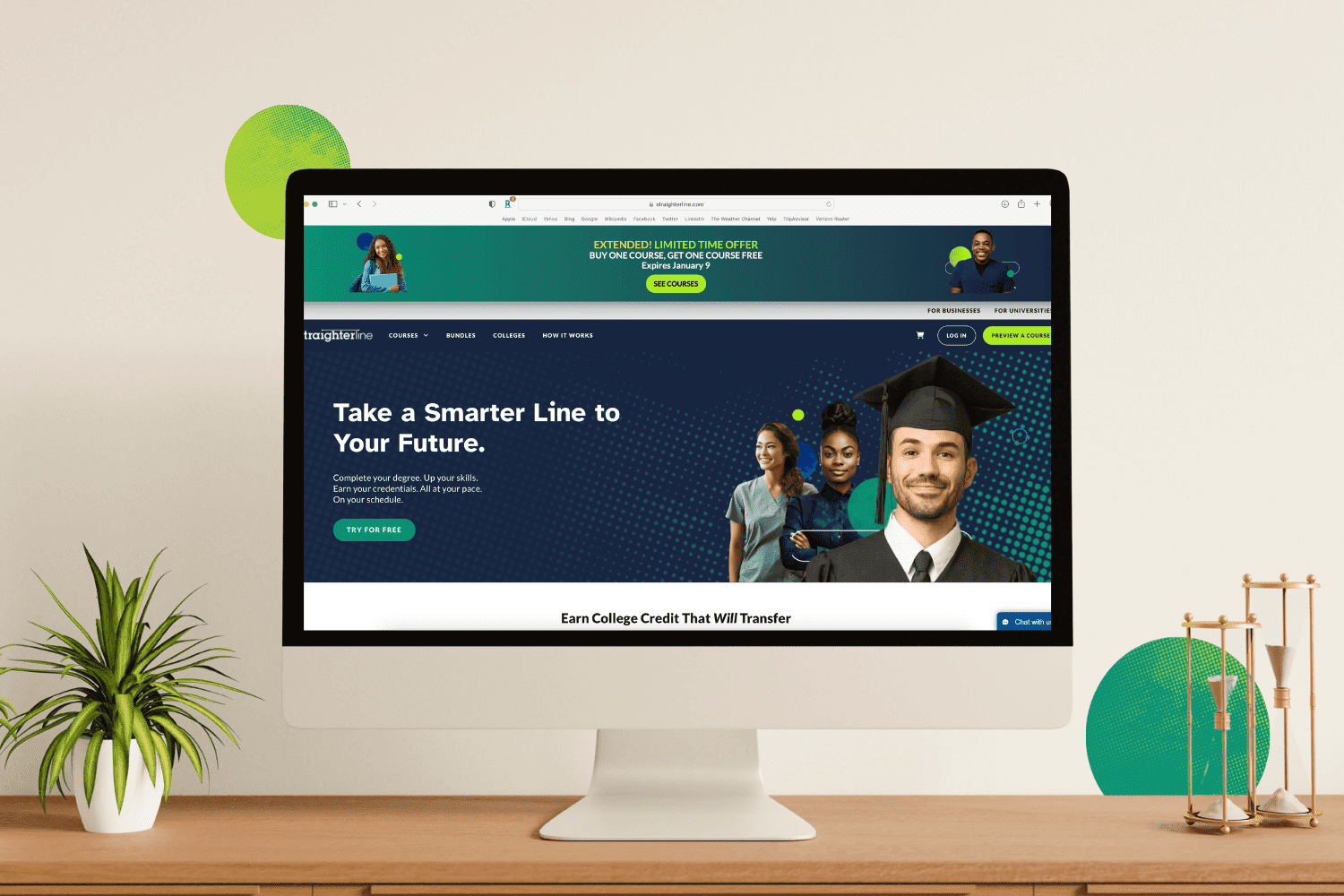
Many adults left college the first time due to financial pressure, emotional stress, or life circumstances outside their control. The difference now is that there are solutions around these roadblocks. Today’s degree completion programs are designed around adult realities, not 18-year-old schedules. That includes flexible options like online college credit providers like StraighterLine, which help students earn transferable credits on a more affordable, self-paced timeline before or alongside a degree program.
Step 1: Get Clear on Your Why and Your Finish Line
Before comparing programs, you need clarity — not perfect clarity, just enough to make good decisions that will get you to your degree this time around.
Start with your real motivation
Why are you finishing your degree now?
Career mobility: Maybe you’ve hit a ceiling where “bachelor’s degree required” keeps showing up.
Higher earnings: According to the Bureau of Labor Statistics, in 2024 full-time workers age 25 and over with a bachelor’s degree had median weekly earnings of $1,533, compared with $946 for those with only a high school diploma. That’s an annual difference of roughly $30,500.
Personal fulfillment: For many adults, finishing is about closing a chapter for themselves or their family.
Most people have more than one reason. That’s okay.
Ask yourself: If I look back three years from now, what would make this feel worth it? That answer becomes your anchor.
Define what “done” actually means
“Finish my degree” can mean very different things:
A specific major (e.g., Business, IT, Healthcare Administration)
Any accredited bachelor’s that unlocks new opportunities
Stackable credentials that lead to a degree over time
A timeline goal, like finishing within two years while working full-time
You don’t need a lifelong commitment. Instead, focus on a clear working definition so you can evaluate programs with confidence.
Be honest about your constraints
Adult degree completion works best when it’s grounded in reality. It’s important to take the following into consideration:
Work: Hours, busy seasons, schedule flexibility
Family or caregiving: Who depends on you and when?
Energy: When do you actually focus best?
Budget: What’s sustainable per term or per month?
This isn’t about limiting yourself. It’s about choosing a path you can maintain.
Step 2: Audit What You Already Have
Before you enroll anywhere, take stock of what you’ve already earned.
Think of this as reclaiming value of credits and experience you’ve already paid for with time, money, and effort.
List every college you’ve attended
Include:
Community colleges
Four-year schools
Credits earned through online programs, such as StraighterLine
Military or training institutions
Colleges see this all the time. Adult learners often have credits from multiple places, and many schools are built to evaluate them efficiently.
Request official transcripts early
Most schools require official transcripts, and processing can take time.
Plan for:
Locating registrar offices
Submitting requests (sometimes with small fees)
Waiting 1–3 weeks for processing
You don’t need to interpret the credits yourself. Just compile what you have so colleges can evaluate them for you.
Ask about transfer policies up front
Many degree completion programs accept up to 90 transfer credits toward a bachelor’s degree.
Here are some key questions to ask:
How many credits do you typically accept?
Do older credits still count?
Do you offer an unofficial transfer review before I apply?
Generous transfer policies can save you months or years on finishing your degree.
Explore credit for prior learning (CPL)
Your work and life experience may count for academic credit through:
Professional certifications
Military training
Employer-based learning
Portfolio reviews or exams
This process exists to recognize college-level learning that’s already happened — not to lower standards or expectations.
Step 3: Choose a Degree Completion Path That Fits Your Life
The goal isn’t to find the “best” school — it’s to find the right one for you.
Look for adult-focused programs
Search for language like:
“Degree completion”
“Designed for working adults”
“Online or asynchronous”
“Transfer-friendly”
These programs are built around adult schedules and responsibilities and not traditional campus life.
Confirm accreditation
Accreditation ensures your degree is recognized by employers, licensing boards, and graduate schools.
Always verify:
Institutional accreditation
Program-specific accreditation when required (e.g., nursing, teaching)
If you’re unsure, ask directly.
Choose a format you can sustain
Common options include:
Online, asynchronous: Flexible scheduling with weekly deadlines
Online, synchronous: Live sessions at set times
Hybrid: Mix of online and in-person
Evening or weekend classes
The best format is the one you can stick with consistently.
Ask about stackable credentials
Some programs allow you to earn certificates or industry credentials that:
Improve your earning power sooner
Count toward your degree later
This is how many adult learners build momentum while finishing strong.
Step 4: Plan Your Time and Budget
Before enrolling, you’ll need to answer two key questions:
How much will finishing a degree cost?
Typical bachelor’s degrees require about 120 credits. With transfer and prior learning credits, you may be closer to this threshold than you think. This means you’ll save big in the long run, compared to if you were starting from the beginning.
Estimate:
Your Remaining credits
Per-credit cost
Then reduce that number by:
Maximizing transfer credits
Applying CPL
Using financial aid
Complete the FAFSA — even if you’re unsure
The FAFSA (Free Application for Federal Student Aid) unlocks:
Federal grants
State aid
Many scholarships
Even adults who previously withdrew often still qualify. If you have loan issues, financial aid counselors can help navigate solutions.
Layer your funding
Look beyond loans:
Adult learner scholarships
Employer tuition reimbursement
Payment plans
The goal is simple: don’t leave money on the table.
Consider Alternative College Credit Platforms
Alternative credit providers can help you earn transferable credits for a fraction of the cost of traditional tuition before or while you enroll in a degree program.
For example, StraighterLine offers:
Credits that transfer to 3,000+ colleges and universities
Self-paced formats so you can move faster when life allows
Digital textbooks included at no extra cost
Built-in tutoring, academic support, and free transcript delivery
For many students, completing general education or prerequisite courses through StraighterLine significantly reduces both time to degree and total tuition cost, without sacrificing quality or transferability.
The key is to:
Confirm which courses transfer to your target school
Use alternative credits strategically for high-cost or high-volume requirements
Stack savings early to lower your overall financial burden
Used wisely, alternative credit platforms can be one of the smartest moves in your degree plan.
Map your weekly time honestly
A common estimate is 2–3 hours of study per credit per week.
Before enrolling:
Identify real study windows
Compare them to course expectations
Adjust credit load or format if needed
Planning now prevents burnout later.
Step 5: Set Yourself Up to Finish
Enrollment is a milestone. Completion is the goal.
Work with an advisor
A good advisor helps you:
Build a term-by-term plan
Apply transfer credits strategically
Balance course difficulty
See your graduation date clearly.
That clarity matters.
Use the support you’re paying for
Modern colleges offer:
Tutoring and writing support
Academic coaching
Career services
Mental health resources
Tech and orientation help
These services exist because adult learners succeed more often when they’re supported.
Build a small support network
Loop in:
Family or housemates
Supervisors or coworkers (when appropriate)
Fellow adult learners
You don’t need a crowd — just people who understand your goal.
Plan for disruptions
Life happens. Decide ahead of time:
Who to contact when you struggle
How leaves or pauses work
How to re-enter smoothly if needed
Resilience isn’t pushing through alone. It’s using the systems around you.
You’re Closer Than You Think
If you’ve read this far, a few things are likely true:
You have more credits and experience than you realized
You know why finishing matters now
You see that adult-focused paths really do exist
And with the right plan, you can cross the finish line this time.
Take Your Next Step with StraighterLine
Whether you need to knock out a few remaining credits, save on tuition, or regain momentum on your own schedule, StraighterLine can help you move forward with confidence. You’ve already done the hard part by deciding to finish.
Check out our courses to get started.
FAQs
What is a degree completion program?
A degree completion program is designed for adults who started college but didn’t finish. These programs focus on transferring existing credits, offering flexible formats, and helping students complete a bachelor’s degree efficiently.
How long does degree completion usually take?
Degree completion timelines vary based on how many credits you already have. Many adult learners finish in 12–24 months, especially when programs accept transfer credits and prior learning.
Can I transfer old college credits into a degree completion program?
Yes. Most degree completion programs accept transfer credits — even from several years ago. Some schools allow up to 90 transfer credits, which can significantly reduce time and cost.
How can StraighterLine help with degree completion?
StraighterLine helps students earn affordable, transferable college credits online before or alongside a degree program. These credits can reduce tuition costs and accelerate degree completion when used strategically.